Doctor Bill for Having a Baby How Many Prenatal Visits Are There in the Whole 9 Months
The Special Supplemental Nutrition Program for Women, Infants, and Children (WIC) is a federal aid plan of the Food and Nutrition Service (FNS) of the United States Department of Agronomics (USDA) for healthcare and nutrition of low-income meaning women, breastfeeding women, and children under the age of v. (See child nutrition programs.) Their mission is to exist a partner with other services that are key to childhood and family unit well-beingness.[one] The basic eligibility requirement is a family unit income below 185% of the federal poverty level. Most states allow automatic income eligibility, where a person or family unit participating in sure benefits programs, such as the Supplemental Nutrition Assistance Program, Medicaid, or Temporary Assistance for Needy Families, may automatically come across the income eligibility requirements. Currently, WIC serves 53 percent of all infants born in the United States.[2]
History [edit]
An amendment to section 17 of the Kid Nutrition Human activity of 1966 on September 26, 1972. The legislation, P.L. 92-433, sponsored by Senator Hubert Humphrey (D) of Minnesota established the Special Supplemental Food Program for Women, Infants, and Children (WIC) as a two-twelvemonth pilot program. Eligibility was limited to children upwardly to age four and excluded non-breastfeeding postpartum women. Past the end of 1974, WIC was operating in 45 states. On Oct seven, 1975, WIC was established every bit a permanent program (P.L. 94-105). Eligibility was extended to non-breastfeeding women (up to six months postpartum) and children up to five years of age. However, all participants must be deemed to be at nutrition risk and with inadequate income (however, what constituted inadequate income was not defined). In 1978, P.L. 95-627 defined diet risk and established income eligibility standards that were linked to the income standards associated with reduced toll school meals. Another income standard change took place in 1989, when P.L. 101-147 established similar income eligibility for Food Postage, Medicaid, and AFDC participation, thus lowering the WIC income standard and simplifying the awarding process. WIC began to promote and support breastfeeding women in the late 1980s, and in 1989 Congress mandated $8 million be used specifically for that purpose. Also in 1999, the WIC program standardized nutrition risk criteria for program eligibility and began assigning individual nutrition risk priority levels.
In December 2000, the White Firm issued an executive memorandum authorizing the WIC programme to begin screening clients for childhood immunization status. The motivation for this was the fact that WIC had the access to the greatest number of depression-income children and thus had the greatest potential for helping immunization rates. They also directed that immunization screening and referral become a standard function of WIC certification. It mentioned that the new WIC minimum immunization screening and referral is simply for employ in the WIC plan. Across WIC programs, it has become standardized as an accurate, efficient and advisable screening and referral process. WIC country and local agencies must coordinate with the providers of immunization screening.[3]
Then, in 2004, the Breastfeeding Peer Counselor Initiative was launched in which women with breastfeeding feel became counselors for women learning how to breastfeed. Five years after in 2009, the USDA introduced a new food bundle with foods consistent with the Dietary Guidelines for Americans too every bit constitute dietary recommendations for young children. In improver, mothers who exclusively breastfeed receive more than good for you foods.[4]
Eligibility [edit]
Applicants to the WIC program must run across eligibility requirements in four areas: (1) categorical, (2) residential, (3) income, and (4) nutrition chance.[5]
- The categorical requirement merely means that each participant must fall into one of three major categories:
- Women:
- Pregnant (during their pregnancy and up to vi weeks after nativity or at the end of the pregnancy)
- Postpartum (up to six months after giving birth or end of pregnancy)
- Breastfeeding (up to their infant's first birthday)
- Infants upward to their get-go birthday
- Children upward to the fifth birthday
- Women:
- Income
- To be eligible on the basis of income, applicants' gross income (i.e. earlier taxes are withheld) must fall at or below 185 percent of the U.Due south. Poverty Income Guidelines.[half-dozen] State income falls betwixt 100 percent and 185 pct of federal poverty guidelines, though most states use the maximum guideline. This is approximately $45k annually for a family in the 48 contiguous since 2016.[7]
- Residential
- Must be a resident of the state to which they are applying for assistance.
- Nutrition risk
- Must have a nutritional risk assessment by a qualified health professional (medico, nurse, or nutritionist). The Nutritional evaluation is based on superlative, weight, and growth cess; hematocrit or hemoglobin levels; full general health history; and a diet
Roles [edit]
The WIC program has three roles:
- to notice out well-nigh a child'due south need for immunization and share that information with parents
- to acquit out minimum immunization screening and referral protocols, not replacing the Land Immunization Program responsibilities
- to implement other measures to increase immunization rates of WIC children.[3]
Services [edit]
General services [edit]
One time applicants meet the eligibility requirements, they can expect to receive WIC assistance in the post-obit four areas:[8]
- Supplemental nutrient
- Food checks or an EBT bill of fare are issued to program participants that allow them to purchase nutritious nutrient that assistance them encounter their needs at stores that have contracted with the government to accept these checks in commutation for merchandise.
- Formula
- WIC Laws and Regulations state, infant formula can only be changed from a non-contracted brand by medical documentation. The formula vouchers provided to the participant are not selected based upon nutritional or health benefits just upon lowest bidder status: "Competitive bidding means a procurement procedure under which FNS or the country agency selects a single source (such as a unmarried baby formula manufacturer offering the lowest price), as determined by the submission of sealed bids, for a product for which bids are sought for use in the Programme."[9]
- Diet education
- WIC participants are offered free wellness and nutrition education classes which help them understand their specific nutrition needs and learn about health prevention and comeback strategies.
- Access to healthcare and other social services
- Program participants receive guidance and assist in accessing other important services such as prenatal programs, immunizations and child clinics, and drug and alcohol handling programs.
- Breastfeeding support
- Program participants too receive guidance and support materials from Certified Lactation Educators about the benefit of breastfeeding and proper breastfeeding techniques.
Nutrition teaching and anemia screening [edit]
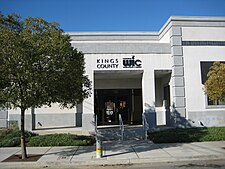
WIC plan services are offered at this office in Hanford, California, by the Kings Canton Department of Public Wellness.
Diet education ranges various topics including salubrious eating, appropriate infant feeding, and breastfeeding. Additionally, the WIC programme also screens for anemia in participants over 12 months erstwhile. Depending on the state, nutrition instruction is provided via a Registered Dietitian, an individual with a bachelor's degree in nutrition or related field, or some other certified professional authority. WIC agencies are required to stress the long-term benefits of nutrition education, although participating in this education is not compulsory for WIC recipients.[x]
Bank check/voucher and EBT bill of fare [edit]
WIC participants ofttimes receive a monthly check or voucher, or more recently an EBT card. The USDA implemented new rules in 2006 that required foods to exist more than price-competitive. This has resulted in the closure of many "WIC Simply Stores". Formerly, these stores charged the maximum permitted under the program, charging up to 16% more than regular stores for the same food.[11] Yet, the WIC program is i of the well-nigh cost-constructive government programs. A written report of birth outcomes showed benefit-to-cost ratios ranging from $one.77 to $three.13 in Medicaid costs saved for each $one spent on WIC.[12]
The WIC check/voucher is a specially designed cheque that is compatible with retail point-of-auction check readers and printers. The front of the bank check displays the recipient's name and recipient number, a begin apply- and an end-utilize date, a list of allowable items to be purchased with the cheque/voucher, including the quantity and/or maximum weight of the allowed items listed. The WIC recipient can choose if they want only some or all of the items listed on the check. The check also has an area for the cashier to enter the sale full, and an area for the recipient to sign the check/voucher at the time of use. The checks make utilize of MICR for enhanced security and ease of processing.
Alternately, many states (notably Texas and Nevada) have moved away from a newspaper organisation of checks and vouchers. The conversion of the WIC program to EBT cards has automated a great bargain of the process and provides better care for the children and mothers currently using WIC. The cards are like to consumer credit/debit cards merely are exclusively used for purchasing WIC-approved items.
Items provided [edit]
The food items provided past WIC are juice (single strength), milk, breakfast cereal, cheese, eggs, fruits and vegetables, whole wheat staff of life, whole grain items including brown rice and tortillas, fish (canned)(for Exclusively Breastfed Mothers), legumes (dry/canned), and peanut butter. The program too provides tofu, soy milk, and medical foods for children and women with various metabolic or other diseases. The food packages provide participant choice and variety. Foods such equally tortillas, brown rice, soy-based beverage, canned salmon, and a wide selection of fruits and vegetables provide State agencies flexibility in prescribing culturally advisable food packages.[13]
Organic fruits, vegetables, legumes and grains are covered under WIC while organic milk, cheese, juice, peanut butter and eggs are non covered under the program. Some organic forms of WIC-eligible foods (e.chiliad., milk, eggs, cheese) meet the nutritional requirements ready forth in WIC regulations and are therefore authorized. Yet, WIC State agencies are responsible for determining the brands and types of foods to authorize on their State WIC nutrient lists. Some State agencies may allow organic foods on their foods lists, just this will vary by Country. The decision may exist influenced by a number of factors such as toll, product distribution inside a State, and WIC participant acceptance.[14]
WIC Certification Visits [edit]
In many state programs, for a WIC certification and health screening process, the staff advises parents to bring their child's immunization records. For some state programs, the screening and referral volition occur at either client check-in, food instrument distribution, or during referral function of certification. They also provide the parents of their child's immunization status as well as provide educational materials on the different immunizations. For families in the community, local WIC agencies should be able to identify providers who offer immunizations in the customs. At the land level, the WIC agencies tin choose to document immunization screening and referrals, forth with many other optional activities. These other activities include making appointments for immunizations, making copies of immunization records, entering immunization records into a registry, and providing other educational fabric.[3]
Responsibilities of recipients [edit]
The usual responsibilities of a WIC recipient are:
- Beingness on time and keeping all appointments. If yous cannot keep an date, notify the WIC function as soon equally possible.
- Giving the WIC office accurate data to determine your eligibility for the WIC Programme.
- Using your WIC checks only at WIC-authorized stores or with WIC authorized farmers.
- Using your WIC checks to buy merely the foods and amounts listed on the checks.
- Using the checks within the "Not Good Earlier" and "Not Good Subsequently" dates printed on the checks.
- Telling the WIC office if yous are planning to move, if your telephone number changes, if your income changes or if you lot want to change to some other WIC function.
- Being courteous to store cashiers, WIC staff and other WIC participants.[15]
Funding [edit]
The WIC program is primarily funded through two carve up federal grants: the food grant, and the nutrition services and administration (NSA) grant. Total funding increased from 2009–2011, merely then began to decrease in 2012.[sixteen]
| Fiscal Twelvemonth | Food Grant | NSA Grant | Total Grant |
|---|---|---|---|
| 2009 | $5,095,205,056 | $ane,870,841,024 | $six,966,046,080 |
| 2010 | $4,991,019,755 | $two,054,406,259 | $7,045,426,014 |
| 2011 | $v,118,743,586 | $2,001,972,626 | $7,120,716,212 |
| 2012 | $5,125,579,756 | $1,948,325,562 | $7,073,905,318 |
| 2013 | $iv,896,354,042 | $i,923,038,134 | $half-dozen,819,392,176 |
| 2014 | $four,910,706,206 | $1,988,901,825 | $half-dozen,899,608,031 |
| 2015 | $4,681,239,224 | $one,989,973,913 | $6,671,213,137 |
| 2016 | $4,602,436,831 | $1,986,501,130 | $half-dozen,588,937,961 |
The majority of WIC funding for country and local agencies comes from the federal government; still, some states notice the need to supplement their funding with exterior resources. In 2011, infant formula rebates generated $one.3 billion nationally.[17]
Participation and Budget Tendency [edit]
Since 1985, total participation in WIC steadily increased from 344,000 to a tiptop of virtually 9.2 million in 2010. After 2010, participation began to driblet as funding decreased and employment began to increment nationwide.[18]
| Fiscal Yr | Total Participation (In Thousands) | Food (Millions) | NSA (Millions) | Total (Millions) | Average Monthly Food Costs per Person (Dollars) |
|---|---|---|---|---|---|
| 2008 | 8,705 | $iv,534.0 | $1,607.6 | $6,188.viii | $43.twoscore |
| 2009 | nine,122 | $four,640.ix | $ane,788.0 | $six,471.6 | $42.40 |
| 2010 | 9,175 | $iv,562.eight | $i,907.ix | $6,689.9 | $41.43 |
| 2011 | 8,961 | $5,018.3 | $1,961.3 | $7,169.6 | $46.69 |
| 2012 | eight,908 | $4,808.5 | $1,877.8 | $6,797.8 | $45.00 |
| 2013 | 8,663 | $iv,497.2 | $one,881.6 | $6,501.7 | $43.26 |
| 2014 | 8,258 | $4,324.iv | $one,903.iv | $6,356.iv | $43.64 |
| 2015 | 8,024 | $4,176.0 | $one,921.ix | $half dozen,238.6 | $43.37 |
| 2016 | seven,696 | $iii,949.6 | $1,946.1 | $half-dozen,018.nine | $42.77 |
| 2017 | 7,286 | $3,606.1 | $ane,964.viii | $5,691.five | $41.24 |
| 2018 | vi,870 | $3,376.6 | $1,977.one | $five,433.half dozen | $40.96 |
[18]
Since 2008, WIC has seen a rise and autumn in the amount of spending. From 2008 to 2011, the full corporeality spent on programs went from close to $6.ii billion to nigh $7.2 billion. In 2012, the amount spent began to fall to about $6.8 billion, mayhap due to the decreasing number of participants.
Literature review [edit]
Nutrition requirements [edit]
A woman, babe or child must meet two standards to exist eligible to receive WIC benefits: (i) nutritional risk and (2) income disparity. Yet according to Peter Germanis and bourgeois AEI scholar Douglas J. Besharov in the SAGE Evaluations Review Periodical, these 2 requirements often fall brusque in determining the existent eligibility for WIC participants. They assert that the thought of "nutritional risk" is too broad of a concept. WIC's current definition of nutritional risk includes different medical conditions such as anemia and low or overweightness. The definition also includes the female parent's history, age, past pregnancy complications, and inadequate nutrition [19]
While some of the nutritional risk standards are clear, Besharov and Germanis farther point out that the majority of people on WIC practise not clearly showroom these symptoms or history. They all the same might take nutritional run a risk, just they do not run into the definition outlined in the policy. Despite the definition of nutrition take a chance, the Establish of Medicine's Committee on Scientific Evaluation of WIC Diet Risk Criteria pointed out that many states have used "generous" cut-off points and "loosely divers take chances criteria". Their inquiry concluded that because the judgment of nutritional risk is left up to the discretion of the doctor, many participants who simply partly need WIC'southward assistance frequently take the spots of those with greater need.
In Feeding the Poor: Assessing Federal Food Help, P.H. Rossi (1988) states that these gaps are often a result of unreliable tools or methods to mensurate nutrition risk, forth with a lack of clarity in the definition of gamble. In the report, Rossi took what are called "street-level bureaucrats" and applied them for WIC. These people were either at marginal or no diet risk, yet they were accepted easily into the WIC plan. This practice essentially turns eligibility into solely a matter of income.[xx]
Income requirements [edit]
The second eligibility standard for participation in the WIC program—income level—also allows for much subjectivity. In theory, to authorize for WIC services, a family unit must accept an income of no more than than 185% of the current federal poverty level. While this definition seems directly frontward, Besharov and Germanis draw many instances in which WIC participants with incomes above this level still received services. This could exist due to the rapid growth of WIC in the past 30 years. Many WIC staff members have reported that because of the rise in funding, local income testing procedures have go less thorough (2000).
Besharov and Germanis aren't the only ones who have noticed discrepancies in the WIC income eligibility requirement. A USDA study demonstrated that 5.seven% of WIC participants were non eligible considering their income was as well high (run into U.Due south. General Bookkeeping Office 1999, 23). Because of this testify, the USDA believes that WIC can reduce funding and still meet the needs of those who truly are in need of aid [21]
Conversely, the aforementioned written report explained that some members of the USDA have ended that the electric current method for estimating eligibility is flawed and reports a much lower number of eligible citizens than really exists. The method is flawed because it measures income on an annual basis instead of a monthly basis. When the researchers compared monthly income to annual income, they establish that the number of income-eligible people increased dramatically a monthly evaluation level. (46-54% increase for infants, and 34-36% increment for older children. No mention of the effect on mothers was mentioned). They ended that if income were measured monthly, and so a larger number of families would exist eligible to participate in WIC [21]
Other enquiry suggests that instead of redefining WIC eligibility requirements, policymakers should better annunciate how lenient the requirements are. In a study published in 2005, Craig Gundersen, a professor in the Department of Nutritional Science at the University of Illinois at Urbana-Champaign, found that many parents stop using WIC funds to care for their children after their children achieve the age of one year. Nevertheless, over 35% of these children are in families that are beneath the poverty line. Only i in nine non-participating children nationwide are ineligible for WIC aid.[ dubious ] The inquiry suggests that parents are unaware that children up to five years of age are still eligible for WIC services; consequently, their children are not getting necessary diet.[22]
To combat this phenomenon, Gundersen suggests that if policymakers want to reach those nearly in demand, they need to target this group of people who were once on WIC and left, not new recipients. His inquiry shows that families that have never received WIC assistance have monthly family incomes $797 higher than those who have left the programme and $1,215 college than those currently on the programme. Clearly, the people who were once on WIC and left have greater need than nearly of those who accept never sought WIC aid.[ original research? ]
Other programs' consequence [edit]
Eligibility for participation in the WIC programme has been afflicted by a number of federal programs and policy changes since the 1980s. The federal government has gradually increased its control over WIC plan policies, which has resulted in a motility abroad from country program command. For instance, the nutritional risk criteria that had previously been instituted by the country cutoffs were standardized by the federal regime in 1999.[23]
In 1989, the Child Nutrition and WIC Reauthorization Human activity increased the corporeality of eligible programme participants past allowing groups such every bit Medicaid, Aid to Families with Dependent Children (AFDC), Temporary Assistance for Needy Families (TANF), and those qualified for food stamps automatically became eligible for WIC assistance. Allowing these groups to be eligible, in effect, raised the income eligibility threshold for WIC services. Participants in the WIC program are now viewed equally those that are inherently eligible considering of an income at 185% below the poverty line or adjunctively eligible through eligibility and participation in the same programs. Research has identified an increase in health benefits among WIC program participants that could offset the boosted costs of Medicaid in the future. Changes in welfare benefits are also estimated to increment the adjunctive eligibility rate.
1998, amendments to the Child Diet and WIC Reauthorization Act were fabricated too every bit amendments to the National Schoolhouse Luncheon Human activity with respect to straight expenditures of agronomical commodities. A state was allowed to match federal funds for meals in private schools. Requirements to use certain WIC funds for the costs of nutrition services and administration were extended[24]
WIC program participation tin be affected by an introduction of new programs or changes to existing policy of programs that affect women, infants, and children. The WIC program assists 73 percent of eligible infants, 38 percent of eligible children, and 67 percent of eligible pregnant and postpartum women (Bitler & Scholz, 2002). If services increase under the TANF program, a specific segment of participants in the WIC programme, such as infants, showed a subtract in participation. Implementation of the TANF programme accounts for a 9.8 percent reduction in WIC program participation.
In addition to current programs that touch eligibility and participation in the WIC program, many states distribute waivers that extend programme rules, change work requirements, and extend program timelines that affect eligibility and participation in WIC.[23]
Internal programs' result [edit]
WIC's impact is affected past internal programs. Some scholars assert that the spending construction needs to be adjusted so a greater number of eligible individuals tin can receive WIC services. Transferring some spending to other parts of the program is under consideration.
Besharov and Germanis argue that a sustained effort to make the program more effective should begin with a policy debate near WIC's part and impacts. "WIC'due south rigid spending rules, for case, forbid local programs from spending more than nearly 30 minutes for nutritional education every half-dozen months with clients." In the commodity "WIC Reauthorization: Opportunities for improving the Nutritional Status of Women, Infants, and Children (2002), authors Play tricks, McManus, and Schmidt from the George Washington Academy, say local WIC agencies are required to make nutrition education bachelor to participants at least twice in each 6-calendar month certification period. The initial nutritional session is ordinarily conducted during the intake engagement with the individual, and subsequent sessions are typically offered in a grouping format lasting well-nigh 10 to 15 minutes. These education sessions are optional than mandatory (2003). This practice raises questions nearly the efficiency of WIC spending. People incertitude the legitimacy of the 30-minute nutritional instruction since information technology is as well brusk to play a part in improving the participant's nutritional status. Therefore, information technology is reasonable to ask: Would it be more than effective and efficient if the spending for this session is transferred to other useful areas?
Based on the data mentioned past Alison Jacknowitz from American Academy and Laura Tiehen from the U.Southward. Department of Agriculture in their article "Transitions into and out of the WIC Program: A Cause for Business organisation?",[25] in 2002 the average retail value of the WIC food do good for infants ages 4–12 months was $100.37 per month; the average retail value of the child food benefit was $39.29 per month (Institute of Medicine, 2006). The higher retail value of the WIC food benefit for infants is due to the inclusion of infant formula. Since the WIC program encourages breast feeding, it raises a question similar to the foregoing: Would it exist more effective and efficient if some of the spending on infant formula is transferred to drawing more participation of WIC, making more people eligible for this program?
Nutrient packet [edit]
Participants of WIC receive checks, vouchers, or electronic cards to purchase food at participating retail markets each month to supplement their diets. The programme food packet is designed to address the specific needs of low-income significant, breastfeeding, and postpartum non-breastfeeding women; infants; and children up to v years of historic period who are nutritionally at risk.
The food purchased with WIC vouchers must be on the approved listing of canonical foods. Upwards until 2005, the list of approved foods was meant to help supplement participant's diets to contain the following priority nutrients: poly peptide, calcium, fe, and vitamins A and C.[26] The literature stated that from the initiation of WIC in 1972 until 2005, the monthly food packages provided by WIC remained largely unchanged despite advances in nutrition noesis, changes in dietary patterns, increased cultural diversity among WIC participants, and a nationwide epidemic of obesity.[27]
Nationwide data showed that WIC participants had inadequate intake of vitamin E, magnesium, calcium, potassium, and fiber while using the original food packages. Participants likewise had an excessive intake of saturated fats, sodium, zinc, and preformed vitamin A.[27] Despite the huge expenditures each month to supplement millions of diets in the state, the programme was not delivering the necessary nutrients to this of import population made up of women, infants, and children during the most critical time in their lives, drastically affecting future health.
In response to the lack of intended program outcomes, the U.South. Department of Agriculture's Food and Nutrition Service assigned the Found of Medicine's Committee to appraise the effectiveness of the food package content.[27] As part of the evaluation, they were to decide the special dietary needs of each subgroup of the WIC participants. This included prioritizing the targeted nutrient intake and offer recommendations for specific changes to the WIC nutrient packages. To do this, the committee was charged with making recommendations that were "culturally suitable, not-crushing to assistants, efficient for nationwide distribution and vendor checkout, and cost-neutral."[27] These recommendations were implemented in the course of supplemental foods that would counteract the deficiencies and excesses of the WIC food package inside the bounds of cost and cultural requirements. This change to the food package was done again in 2009, which put the nutrient package in compliance with the 2005 Dietary Guideline for Americans. This modify introduced an inclusion of cash-value vouchers for fruits, vegetables, whole-wheat bread, corn or whole-wheat tortillas, brownish rice, oats, bulgur, and barley. Milk purchase options were as well altered to only include lower-fat milk for all women and all children over two years of age. The aligning in the nutrient parcel had a pregnant effect on participant nutrition.[28]
The literature suggested that there has been a significant increase in the overall nutrition of WIC participants as a result of these food package changes. Participants were surveyed before and after the new food package implementations. The information showed that there was a 17.3 percentage signal increase in whole wheat consumption and a 7.2 percentage point increase in the amount of vegetables consumed.[28]
Currently, WIC food packages include infant cereal, atomic number 26-fortified adult cereal, fruit rich in vitamin C, vegetable juice, eggs, milk, cheese, peanut butter, beans, and fish. WIC has recently expanded this list to also include soy-based beverages, tofu, babe foods, whole-wheat staff of life, and a variety of fruits and vegetables.[26]
The literature painted a clear picture of the improvements that have been made and the effect the food parcel change has fabricated in increasing the nutrition of WIC participants.[28] The literature was likewise helpful in giving a articulate blueprint for time to come changes in the WIC program including specialty committees, information collection on health effects, food selection, implementation, surveying for effectiveness.[27] Time to come changes to the food package will exist evaluated in the aforementioned ways and data will be compared.
National savings in healthcare costs [edit]
WIC has dramatically reduced healthcare costs by (a) providing prenatal services, and (b) promoting breastfeeding. Several controlled evaluations have shown that women who receive prenatal WIC services have lower hospital costs for both them and their infants than women who did non receive WIC services. In 1992, prenatal WIC enrollment was estimated to have reduced first yr medical costs for U.S. infants by $1.19 billion, more than offsetting the authorities'south cost of WIC.[29]
Prenatal apply of WIC services also decreases the odds of having a depression birth-weight newborn by 25 percent and reduces very depression birth-weight births past 44 percent.[30] Having a higher birth-weight newborn has the potential to decrease costs for hospitalization in the kickoff twelvemonth, since infants with lower birth-weight have college costs for initial hospitalization and college re-hospitalization costs.[31] Every dollar spent on prenatal WIC benefits re-sulted in a savings of $0.93 for the Federal Government, $0.77 for State governments, and an additional $i.37 for private payers, hospitals, and in-surers' ($3.07 total) costs.[29] Because of these savings, WIC is often cited as being one of the about cost-effective food assistance programs in the nation.
I reason that WIC is known every bit existence toll-effective is explained in a report done in 1993 by Debbie Montgomery and Patricia Splett where they showed that promotion of chest-feeding in the WIC plan is an effective cost-containment activity. The written report revealed that WIC users who exclusively breastfed their children during the first six months of the child's life incurred a savings of $112 in Medicaid costs per infant. The average pharmacy payments were $29.82 lower for males and $12.16 lower for females who were breast-fed.[32]
Research problems and limitations [edit]
Historically, WIC has been portrayed as an efficient and effective use of taxpayer dollars. Finding or conducting inquiry that conclusively proves that portrayal is somewhat difficult. Two challenges exist, finding research that encompasses all areas of WIC and conducting scientific inquiry.
Research on WIC tends to focus on the help provided to pregnant women and newborns. The inquiry on this part of WIC shows that the help provided is effective and the system is efficient. These results are and then used to determine that all of the WIC programs are effective. The problematic part is that the services provided to pregnant women and newborns only business relationship for 12% of the program. At that place are precious few studies that examine the effectiveness and efficiency of the other 88% of WIC. (Besharov and Germanis)[33]
Conducting scientific enquiry on an aid plan like WIC is besides problematic. Offset, it is difficult, if non impossible, to establish a command group. To do so would require a researcher to take people asking for aid and so split up them into two groups. Aid would so need to be denied to one of the groups. This would be unethical. Second, it is difficult to business relationship for other variables that could bear upon infant and children health, in addition to the help provided past WIC. An example would be parental motivation. How do y'all decide if the results of WIC were considering of the plan or due to effective parenting? More than effective parents may be more than likely to seek WIC assist earlier and longer. That may be the existent reason for success rather than how the plan is delivered. (Besharov and Germanis)
Future challenges [edit]
According to Nutrient & Nutrition Services (FNS), WIC is one of the nation's nearly successful and cost-effective nutrition intervention programs. In spite of its success, the WIC plan, as with any program that involves coordination and communication between many people, faces challenges in delivering diet services, such equally the coordination of its nutrition services with changing health and welfare programs. Welfare reform increases demands on WIC direction in performing outreach and coordination. New health challenges include the "obesity epidemic". The census of the low-income population that the WIC program serves is constantly changing. Retentivity of staff, employment of paraprofessionals, and the allocation of resources for staff training are additional challenges, along with the utilize of it to assess the upshot of nutrition services and to raise service delivery and program direction within the limits of programme funding.
In the low-cal of the in a higher place challenges, the United States Full general Accounting Part (GAO) did research and made recommendations to USDA that would help information technology to place strategies that will accost WIC's challenges in recruiting and retaining a skilled staff and assessing the effects of nutrition services. It was recommended that:
- USDA should piece of work with Economic Research Service and the National Association of WIC Directors to comport an assessment of the staffing needs of land and local WIC agencies. This assessment should examine factors such as staffing patterns, vacancies, salaries, benefits, duties, turnover, and retention.
- USDA should piece of work with the Economic Research Service, the National Association of WIC Directors, and other stakeholders, including the CDC, to develop a strategic plan to evaluate the impacts of specific WIC nutrition services. This programme should include information on the types of inquiry that could be washed to evaluate the impacts of specific diet services equally well equally the data and the financial resources that are needed.
References [edit]
- ^ "Immunization Screening and Referral in WIC". United States Department of Agriculture Food and Nutrition Service . Retrieved 20 November 2006.
- ^ "Near WIC- WIC at a Glance". world wide web.fns.usda.gov/wic. Retrieved 2013-11-19 .
- ^ a b c Starbuck, Debbie. "Implementing the New WIC Policy for Immunization Screening and Referral" (PDF). United States Section of Agriculture Food and Diet Services . Retrieved eighteen November 2015.
- ^ Greenaway, Douglas. "WIC Plan Overview and History". National WIC Association . Retrieved 18 November 2015.
- ^ "WIC Eligibility Requirement States Department of Agronomics Food and Diet Service". Retrieved 2013-12-06 .
- ^ "WIC Income Eligibility Thousand". United States Department of Agriculture Food and Nutrition Service . Retrieved 2013-12-06 .
- ^ "WIC". The states Department of Agriculture Food and Nutrition Service. 2016-04-05. Retrieved 2013-12-06 .
- ^ Orangish County Wellness Care Bureau. (2011). Public health services. Retrieved from http://ochealthinfo.com/public/diet/wic Archived 2012-01-21 at the Wayback Machine
- ^ "Archived re-create" (PDF). Archived from the original (PDF) on 2012-05-31. Retrieved 2012-05-22 .
{{cite spider web}}: CS1 maint: archived re-create as title (link) - ^ "Function 246—Special Supplemental Nutrition Plan for Women, Infants, and Children" (PDF) . Retrieved 11 Baronial 2012.
- ^ Goodwin, Jenifer (2004-07-04). "Pricing loophole benefits state food voucher stores | The San Diego Union-Tribune". Signonsandiego.com. Retrieved 2012-08-12 .
- ^ Devaney, Barbara (7 December 2007). WIC Turns 35: Program Effectiveness and Hereafter Directions (PDF). National Invitational Conference of the Early Childhood Inquiry Collaborative. Retrieved 21 Feb 2012.
Citing: Devaney, Barbara; Bilheimer, Linda; Schore, Jennifer (1992). "Medicaid costs and nascency outcomes: The effects of prenatal WIC participation and the utilize of prenatal care". Journal of Policy Analysis and Management. 11 (4): 573–592. doi:x.2307/3324956. JSTOR 3324956. PMID 10121542. - ^ "How do the food packages entreatment to WIC's culturally diverse populations?". Fns.usda.gov. Retrieved 2013-12-06 .
- ^ "Are organic foods WIC-eligible?". Fns.usda.gov. Retrieved 2013-12-06 .
- ^ "WIC Participant Handbook for Women, Infants, and Children". www.health.ny.gov.
- ^ "Funding and Program Data". Retrieved Nov 4, 2013.
- ^ "Nutrition Program Facts" (PDF) . Retrieved December 6, 2013.
- ^ a b "WIC Data Tables". Retrieved September 12, 2019.
- ^ Besharov, D. J.; Germanis, P. (2000). "Evaluating WIC". Evaluation Review. 24 (2): 123–190. doi:10.1177/0193841x0002400201. PMID 10848457. S2CID 17515251.
- ^ Rossi, P. H. (1998). Feeding the poor: Assessing federal food aid. Washington, D.C.: AEI Press.
- ^ a b Play a joke on, H. B., McManus, M. A., & Schmidt, H. J. (2003). WIC reauthorization: Opportunities for improving the nutritional status of women, infants, and children. National Wellness Policy Forum. 1-35. Retrieved from http://www.nhpf.org/library/groundwork-papers/BP_WIC2_8-03.pdf(National Enquiry Quango, 2003).
- ^ Gundersen, C (2005). "A dynamic assay of the well-being of WIC recipients and eligible non-recipients". Children and Youth Services Review. 27 (ane): 99–114. doi:ten.1016/j.childyouth.2004.08.014.
- ^ a b Swann, C. A. (2010). "WIC Eligibility and Participation: The Roles of Changing Policies, Economic Atmospheric condition, and Demographics". The B.E. Journal of Economic Analysis & Policy. 10 (ane): 1–37. doi:ten.2202/1935-1682.2352. S2CID 54190012.
- ^ Lugar, Richard. "Child Diet and WIC Reauthorization Amendments of 1998". Library of Congress . Retrieved xviii Nov 2015.
- ^ Jacknowitz, A.; Tiehen, Fifty. (2009). "Transitions into and out of the WIC programme: A crusade for concern". Social Service Review. 83 (ii): 151–183. doi:10.1086/600111. JSTOR 10.1086/600111. S2CID 15442638.
- ^ a b Hoynes, H.; Folio, Chiliad.; Stevens, A. H. (2011). "Can targeted transfers meliorate nascency outcomes?: Evidence from the introduction of the WIC program". Journal of Public Economics. 95 (7–8): 813–827. doi:10.1016/j.jpubeco.2010.12.006.
- ^ a b c d e Committee to Review the WIC Food Packages (2005). WIC Food Packages: Fourth dimension for a alter. The National Academies Printing. Retrieved from http://www.nap.edu/openbook.php?record_id=11280&page=ii
- ^ a b c Whaley, S. Eastward.; Ritchie, Fifty. D.; Spector, P.; Gomez, J. (2012). "Revised WIC food bundle improves diets of WIC families". JNEB. 44 (3): 204–209. doi:10.1016/j.jneb.2011.09.011. PMID 22406013.
- ^ a b Avruch, Sheila; Puente Cackley, Alicia (1995). "Savings Achieved by Giving WIC Benefits to Women Prenatally". Public Health Reports. 110 (1): 27–34. PMC1382070. PMID 7838940.
- ^ Avruch, Sheila; Puente Cackley, Alicia (1995). "Savings Accomplished by Giving WIC Benefits to Women Prenatally". Public Health Reports. 110 (ane): 32. PMC1382070. PMID 7838940.
- ^ Avruch, Sheila; Puente Cackley, Alicia (1995). "Savings Accomplished by Giving WIC Benefits to Women Prenatally". Public Wellness Reports. 110 (1): 28. PMC1382070. PMID 7838940.
- ^ Montgomery, Debbie L.; Splett, Patricia 50. (1997). "Economic Benefit of Breast-Feeding Infants Enrolled in WIC". Journal of the American Dietetic Association. 97 (4): 379–385. doi:10.1016/s0002-8223(97)00094-1. PMID 9120189.
- ^ Besharov, Douglas J. and Germanis, Peter. Is WIC as Good Every bit They Say. Web. University of Maryland Schoolhouse of Public Policy, Welfare Reform Academy. world wide web.welfareacademy.org.
External links [edit]
- "Women, Infants, and Children (WIC)". Food and Nutrition Service . Retrieved October 8, 2014.
{{cite spider web}}: CS1 maint: url-status (link) - "About WIC- WIC at a Glance". Retrieved November 19, 2013.
{{cite spider web}}: CS1 maint: url-status (link) - California WIC
- National WIC Association, a non-profit system is support of the WIC program
- WIC programs
- Wisconsin WIC Association, a not-profit organization in support of the WIC program
- The WIC Program: Groundwork, Trends, and Economic Issues The states Department of Agriculture
Source: https://en.wikipedia.org/wiki/WIC
0 Response to "Doctor Bill for Having a Baby How Many Prenatal Visits Are There in the Whole 9 Months"
Publicar un comentario