Barry Commoner Washington University in St Louis Arts and Sciences
| Barry Commoner | |
|---|---|
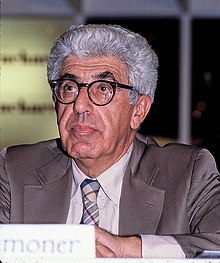 Commoner in 1980 | |
| Built-in | (1917-05-28)May 28, 1917 Brooklyn, New York, United states of america |
| Died | September thirty, 2012(2012-09-30) (aged 95) Manhattan, New York, United States |
| Education | Columbia University Harvard University |
| Occupation | Biologist |
| Spouse(due south) | Gloria Gordon (divorced; 2 children) Lisa Feiner (yard. 1980) |
| Awards | Newcomb Cleveland Prize (1953) |
Barry Commoner (May 28, 1917 – September 30, 2012) was an American cellular biologist, college professor, and politician. He was a leading ecologist and among the founders of the modern environmental motion. He was the director of the Heart for Biology of Natural Systems[one] [2] and its Critical Genetics Projection.[3] [four] [5] He ran as the Citizens Party candidate in the 1980 U.S. presidential ballot.[6] His piece of work studying the radioactive fallout from nuclear weapons testing led to the Nuclear Test Ban Treaty of 1963.[7]
Early life [edit]
Commoner was born in Brooklyn, New York, on May 28, 1917, the son of Jewish immigrants from Russia.[8] He received his bachelor'south degree in zoology from Columbia University in 1937 and his chief'south and doctoral degrees from Harvard University in 1938 and 1941, respectively.[nine]
Career in academia [edit]
After serving as a lieutenant in the US Navy during World War II,[x] Commoner moved to St. Louis, Missouri, and he became an acquaintance editor for Science Illustrated from 1946 to 1947.[eleven] He became a professor of plant physiology at Washington University in 1947 and taught there for 34 years. During this menstruation, in 1966, he founded the Heart for the Biological science of Natural Systems to study "the scientific discipline of the total environment".[1] Commoner was on the founding editorial board of the Journal of Theoretical Biology in 1961.
The greatest unmarried crusade of environmental contagion of this planet is radioactivity from test explosions of nuclear weapons in the temper.
— Barry Commoner, Fallout and Water Pollution–Parallel Cases[12]
In the late-1950s, Commoner became known for his opposition to nuclear weapons testing, condign part of the team which conducted the Infant Molar Survey, demonstrating the presence of Strontium ninety in children'southward teeth as a direct result of nuclear fallout.[13] [14] In 1958, he helped found the Greater St. Louis Committee on Nuclear Information.[15] Shortly thereafter, he established Nuclear Information, a mimeographed newsletter published in his part, which after went on to become Surroundings magazine.[xiii] Commoner went on to write several books about the negative ecological furnishings of atmospheric (i.e., in a higher place-basis) nuclear testing. In 1970 he received the International Humanist Award from the International Humanist and Upstanding Matrimony.
Environmental books [edit]
The Closing Circle [edit]
In his 1971 bestselling book The Closing Circle, Commoner suggested that the Usa economy should exist restructured to adapt to the unbending laws of ecology.[xvi] For example, he argued that polluting products (like detergents or synthetic textiles) should be replaced with natural products (like soap or cotton and wool).[16] This volume was one of the first to bring the thought of sustainability to a mass audience.[16] Commoner suggested a left-wing, eco-socialist response to the limits to growth thesis, postulating that capitalist technologies were chiefly responsible for environmental degradation, equally opposed to population pressures. He had a long-running debate with Paul R. Ehrlich, writer of The Population Bomb and his followers, arguing that they were too focused on overpopulation as the source of environmental issues, and that their proposed solutions were politically unacceptable because of the coercion that they unsaid, and considering the price would fall disproportionately on the poor. He believed that technological, and above all, social, development would pb to a natural decrease in both population growth and environmental harm.[17]
One of Commoner's lasting legacies is his four laws of ecology, as written in The Endmost Circle in 1971.[18] The four laws are:[19]
- Everything is connected to everything else. In that location is one ecosphere for all living organisms and what affects i, affects all.
- Everything must go somewhere. There is no "waste" in nature and there is no "away" to which things can be thrown.
- Nature knows best. Humankind has fashioned technology to improve upon nature, but such change in a natural system is, says Commoner, "likely to exist detrimental to that arrangement"
- There is no such thing as a gratis lunch. Exploitation of nature will inevitably involve the conversion of resource from useful to useless forms.
The Poverty of Power [edit]
Commoner published another bestseller in 1976, The Poverty of Ability.[16] In that volume, he addressed the "iii e'south" that were plaguing the United States in the 1970s, the three east's being the environs, energy, and the economy.[20] "Commencement there was the threat to environmental survival; then there was the apparent shortage of free energy; and at present there is the unexpected decline of the economy."[21] He argued that the iii issues were interconnected: the industries that used the well-nigh energy had the highest negative impact on the environment. The focus on not-renewable resources as sources of energy meant that those resources were growing scarce, thus pushing up the price of energy and hurting the economy. Towards the book's end, Commoner suggested that the problem of the three e'southward is caused by the capitalistic system and can only be solved by replacing it with some sort of socialism.[16]

Time reported in its Feb 1970 issue that "the national business organization over the surroundings has reached an unprecedented level of intensity." On the embrace, the visage of Barry Commoner projected a powerful prototype of ecology, which took the stage for the first fourth dimension in the public eye. [22]
Making Peace with the Planet [edit]
In 1990, Commoner published Making Peace With the Planet, an assay of the ongoing environmental crisis in which he argues that the manner we produce appurtenances needs to exist reconstrued.
Poverty and population [edit]
Commoner examined the relationship between poverty and population growth, disagreeing with the manner that relationship is oftentimes formulated. He argued that rapid population growth of the developing globe is the event of its non having adequate living standards, observing that information technology is poverty that "initiates the rise in population" earlier leveling off, not the other fashion around.[23] Developing countries were introduced to the living standards of developed nations, but were never able to fully adopt them, thus preventing these countries from advancing and thereby decreasing the rate of their population growth.
Commoner maintained that developing countries are yet "forgotten" to colonialism. These developing countries were, and economically remain, "colonies of more adult countries".[23] Considering Western nations introduced infrastructure developments such every bit roads, communications, engineering, and agronomical and medical services every bit a significant part of their exploitation of the developing nations' labor force and natural resources,[23] the showtime footstep towards a "demographic transition" was met, but other stages were non achieved because the wealth created in developing countries was "shipped out", then to speak, to the colonizer nations, enabling the latter to accomplish the more than avant-garde "levels of demographic transition", while the colonies connected on without achieving the second stage, which is population balancing.
"Thus colonialism involves a kind of demographic parasitism: the second population-balancing phase of the demographic transition in the advanced country is fed by suppression of that same stage in the colony".[23] "As the wealth of the exploited nations was diverted to the more powerful ones, their power, and with it their capacity to exploit increased. The gap between the wealth of nations grew, equally the rich were fed by the poor".[23] This exploitation of resources extracted from developing nations, aside from its legality, led to an unforeseen problem: rapid population growth. The demographer, Nathan Keyfitz, ended that, "the growth of industrial capitalism in the Western nations during the menstruum 1800–1950 resulted in the development of a 1-billion excess in the world population, largely in the tropics".[23]
This is evident in the study of India and contraceptives, in which family planning failed to reduce the birth rate because people felt that "in gild to advance their economic state of affairs", children were an economic necessity. The studies bear witness that "population control in a country like India depends on the economically motivated desire to limit fertility".[23]
Commoner's solution is that wealthier nations need to help exploited or colonized countries develop and "achieve the level of welfare" that developed nations accept. This is the only path to a counterbalanced population in these developing countries. Commoner states that the only remedy for the earth population crisis, which is the event of the abuse of poor nations past rich ones, is "returning to the poor countries enough of the wealth taken from them to give their peoples both the reason and the resource voluntarily to limit their own fertility".[23]
His determination is that poverty is the master crusade of the population crunch. If the reason behind overpopulation in poor nations is the exploitation by rich nations made rich by that very exploitation, then the simply way to end it is to "redistribute [the wealth], amidst nations and within them".[23]
2000 Dioxin Arctic written report [edit]
In September 2000, a report published by the Northward American Commission on Environmental Cooperation, lead by Commoner, constitute that Inuit women in the Arctic in Nunavut, Canada were institute to have high levels of dioxin in their chest milk.[24] The study tracked the origin of the dioxins using computer models from the sources that produced it and institute that the dioxin pollution in the Arctic originated from the Usa.[25] Out of 44,000 sources of dioxin polluters in the U.s., they institute that merely xix were contributing to greater than a third of the dioxin pollution in Nunavut. Out of these nineteen, Harrisburg'south incinerator was institute to be the superlative source of dioxin pollution. [26] [27] [25] He was a recipient of the 2002 Joe A. Callaway Award for Borough Courage.[28]
Influence [edit]
Time magazine introduced a section on the environment in their February 1970 issue, featuring articles on the "environmental crunch", and a quote from Richard Nixon's State of the Matrimony address, calling it, "The great question of the '70s". Nixon said, "Shall nosotros surrender to our surround or shall we brand our peace with nature and brainstorm to make reparations for the harm we have done to our air, to our land and to our water?"[29]
The magazine called Commoner, the "Paul Revere of ecology" for his work on the threats to life from the environmental consequences of fallout from nuclear tests and other pollutants of the h2o, soil, and air.[30] Time'southward cover represented a "telephone call to arms", to mobilize public opinion by appeals to censor.[22] The following month, the kickoff Earth Day took place, which saw 20 one thousand thousand Americans demonstrating peacefully in favor of ecology reform, accompanied by several events held at academy campuses beyond the Usa. The publications of Commoner are also considered influential in the conclusion of the Nixon administration in the following June to announce the formation of the Ecology Protection Agency (EPA) and the Make clean Air Act of 1970.[22]
Political activism [edit]
In 1980, Commoner founded the Citizens Party to serve as a vehicle for his ecological bulletin, and he ran for president of the United States in the 1980 US election. His vice presidential running mate was La Donna Harris, the Native-American wife of Fred Harris, a former Democratic senator from Oklahoma, although she was replaced on the ballot in Ohio by Wretha Hanson.[31] [32] His candidacy for president on the Citizens Party ticket won 233,052 votes (0.27 percent of the total).[33]
After his presidential bid, Commoner returned to New York Urban center and moved the Eye for the Biological science of Natural Systems to Queens Higher. He stepped down from that post in 2000. At the time of his expiry, Commoner was a senior scientist at Queens College.
Personal life [edit]
After serving in Globe War II, Commoner married the sometime Gloria Gordon, a St. Louis psychologist.[34] They had two children, Frederic and Lucy Commoner, and one granddaughter. Following a divorce, in 1980 he married Lisa Feiner,[35] whom he had met in the course of her piece of work every bit a public-Goggle box producer.
Expiry and legacy [edit]
Commoner died on September xxx, 2012, in Manhattan, New York.[36] [37]
He was a member of the American Association for the Advancement of Science and has a star on the St. Louis Walk of Fame.[38]
In 2014 the Heart for Biological science of Natural Systems[39] at Queens Higher was renamed The Barry Commoner Center for Wellness and the Environment.[40]
Works [edit]
- Books
- Science and Survival (1966), New York: Viking OCLC 225105 - on "the uses of scientific discipline and engineering in relation to ecology hazards"[xv]
- The Closing Circumvolve: Nature, Man, and Technology (1971), New York: Knopf ISBN 978-0-394-42350-0.
- The Poverty of Power: Energy and the Economic Crisis (1976), New York: Random Business firm ISBN 978-0-394-40371-7.
- The Politics of Energy (1979), New York: Knopf ISBN 978-0-394-50800-9.
- Making Peace With the Planet (1990), New York: Pantheon ISBN 978-0-394-56598-9.
- Reports
- "Long-range Air Ship of Dioxin from North American Sources to Ecologically Vulnerable Receptors in Nunavut, Arctic Canada", (2000), Commoner, Barry; Bartlett, Paul Woods; Eisl, Holger; Couchot, Kim; Center for the Biological science of Natural Systems, Queens College, Urban center University of New York, published past the North American Commission for Environmental Cooperation, Montréal, Québec, Canada.
References [edit]
Notes [edit]
- ^ a b Daum, Karl (Winter 2012–13). "Obituaries: Barry Commoner '37, Environmental and Social Activist". Columbia Higher Today. Columbia College. Retrieved September 28, 2020.
He also founded the Heart for Biology of Natural Systems in 1966 to promote research on ecological systems. In 2000, he stepped downward as director to concentrate on new research projects of his own.
- ^ "Barry Commoner". Barry Commoner Center for Health and the Surroundings . Retrieved September 27, 2020.
- ^ "Programme". Disquisitional Genetics Project. Queens Higher, Urban center University of New York. December 4, 2002. Archived from the original on February xi, 2003. Retrieved September 28, 2020.
The program has been underway since February 2001. An initial belittling paper, "Unraveling the Deoxyribonucleic acid Myth," has been published in the Harper's Magazine issue of February 2002....The Critical Genetics Project is a program of the Center for the Biological science of Natural Systems (CBNS), Queens College, Urban center University of New York
- ^ U.S. Newswire (January 2002). "New Report Challenges Fundamentals of Genetic Engineering; Study Questions Safety of Genetically Engineered Foods". The Pure Water Gazette. Pure Water Products, LLC. Retrieved September 28, 2020.
The study reported in Harper'due south Magazine is the initial publication of a new initiative called The Critical Genetics Project directed by Dr. Commoner in collaboration with molecular geneticist Dr. Andreas Athanasiou, at the Center for the Biological science of Natural Systems, Queens College, City Academy of New York.
- ^ Commoner, Barry (February one, 2002). "Unraveling the Dna myth". Harper's Magazine . Retrieved September 28, 2020.
- ^ Vinciguerra, Thomas (June 19, 2007). "A Conversation with Barry Commoner: At xc, an Environmentalist From the '70s Yet Has Hope". The New York Times . Retrieved October 2, 2012.
- ^ Lewis, Daniel (October 1, 2012). "Scientist, Candidate and Planet Globe's Lifeguard". The New York Times . Retrieved March eleven, 2018.
- ^ Rupert Cornwell (Oct 6, 2012). "Barry Commoner: Scientist who forced environmentalism into the world'southward consciousness". The Independent . Retrieved Nov 8, 2012.
- ^ "Barry Commoner, C250: Columbia Celebrates Columbians Ahead of their Time.". Archived from the original on February 14, 2008. Retrieved February twenty, 2008.
- ^ Mongillo, John F. (2011). Ecology Activists. Greenwood Publishing Grouping. p. 61.
- ^ Hamilton, Neil (2014). American Social Leaders and Activists. Infobase Publishing. p. 87.
- ^ Commoner, Barry (December 1964). "Fallout and H2o Pollution–Parallel Cases". Scientist and Denizen. vii–2: ii. doi:10.1080/21551278.1964.9958599.
- ^ a b McGowan, Alan H. (March–April 2013). "Remembering Barry Commoner". Environment. 55 (two): 17. doi:10.1080/00139157.2013.765312. S2CID 154917172.
- ^ Krasner, William (March–April 2013). "Baby Tooth Survey: First Results". Environs. 55 (two): 18–24. doi:ten.1080/00139157.2013.765314. S2CID 154576170. Reprinted from Nuclear Information iv (1), 1961
{{cite journal}}: CS1 maint: postscript (link) - ^ a b Gottlieb, Robert. 1993. Forcing the Spring. Washington, D.C.: Island Press, p.172. ISBN one-55963-122-viii
- ^ a b c d east Herrera, Philip (May 31, 1976). "Books: Learning the Three Es". Time. Archived from the original on January 18, 2005. Retrieved October 2, 2012.
- ^ Commoner, Barry (May 1972). "A Message Dialogue: on "The Closing Circle" - Response". Bulletin of the Atomic Scientists. 28: 17–56. doi:10.1080/00963402.1972.11457931.
Population command (equally singled-out from voluntary, self-initiated control of fertility), no affair how disguised, involves some measure of political repression, and would burden the poor nations with the social cost of a situation—overpopulation—which is the current upshot of their previous exploitation, as colonies, by the wealthy nations.
- ^ Egan, Michael (2007). Barry Commoner and the Science of Survival: The Remaking of American Environmentalism. Cambridge, Mass.: MIT. pp. 126–127. ISBN978-0-262-05086-ix.
- ^ Miller, Stephen (October 1, 2012). "Early on Voice for Environment Warned About Radiation, Pollution". The Wall Street Journal . Retrieved October 2, 2012.
In his 1971 best seller The Closing Circumvolve, Mr. Commoner posited four laws of ecology: that everything is connected, that everything must get somewhere, 'Nature knows best', and 'There is no such thing as a free luncheon'.
- ^ Kalman, Laura (2010). Right Star Ascent: A New Politics, 1974-1980. New York: West.W. Norton & Co., Ltd. p. 38. ISBN9780393076387 . Retrieved July 24, 2017.
- ^ Barry Commoner, The Poverty of Power (1976), p. 1.
- ^ a b c Eldon H. Franz (2001). "Ecology, Values, and Policy". BioScience. 51 (6): 469–474. doi:10.1641/0006-3568(2001)051[0469:EVAP]2.0.CO;2.
- ^ a b c d e f k h i Commoner, Barry (August–September 1975). "How Poverty Breeds Overpopulation and Non the Other Way Around". Ramparts: 1–6. Archived from the original on July xx, 2012.
- ^ Lucas, Anne Eastward. Lucas (2004). Rachel Stein (ed.). New Perspectives on Environmental Justice: Gender, Sexuality, and Activism. Rutgers Academy Press. p. 191.
- ^ a b Hilts, Philip (October 17, 2000). "Dioxin in Arctic Circumvolve Is Traced to Sources Far to the South". The New York Times . Retrieved March 10, 2018.
- ^ Commoner, Barry; et al. "Long-range Air Transport of Dioxin from North American Sources to Ecologically Vulnerable Receptors in Nunavut, Arctic Canada" (PDF). Committee for Environmental Cooperation. p. 83. Retrieved March 11, 2018.
- ^ Capozza, Korey (June 6, 2009). "U.S. Hazardous to Health?". International Reporting Projection . Retrieved March 10, 2018.
- ^ Joe A. Callaway Awards For Borough Backbone Past-Winners, Calloway Awards, 2002. Retrieved November 11, 2019.
- ^ "Fighting to Relieve the Earth from Human being". Time. Feb ii, 1970.
- ^ "Environment: Paul Revere of Environmental". Time. February 2, 1970.
- ^ [1] Archived Nov 20, 2005, at the Wayback Auto
- ^ "Woods County, 1980-1989" (PDF). August 4, 2003. Archived from the original (PDF) on October 25, 2003.
- ^ 1980 Presidential General Election Results, US Elections Atlas
- ^ "Barry Commoner Biography". The Gale Grouping, Inc. Retrieved October i, 2012.
- ^ Lewis, Daniel (October 1, 2012). "Barry Commoner, Environmental Scientist and Scholar, Dies at 95". The New York Times . Retrieved October 1, 2012.
- ^ "Barry Commoner, Environmental Scientist and Scholar, Dies at 95". The New York Times. October 1, 2012. Retrieved Oct i, 2012.
Barry Commoner, a founder of modern ecology and 1 of its most provocative thinkers and mobilizers, died Dominicus in Manhattan. He was 95 and lived in Brooklyn Heights.
- ^ Dreier, Peter (Oct 1, 2012). "Barry Commoner, Pioneering Ecology Scientist and Activist, Dies at 95". Huffington Post . Retrieved October 1, 2012.
- ^ St. Louis Walk of Fame. "St. Louis Walk of Fame Inductees". stlouiswalkoffame.org. Archived from the original on June 2, 2008. Retrieved April 25, 2013.
- ^ "CBNS: Middle for the Biology of Natural Systems". Center for the Biology of Natural Systems. Flushing, New York: Queens College, City University of New York. September 30, 1997. Archived from the original on October 12, 1997. Retrieved September 28, 2020.
CBNS is a inquiry organization with considerable experience in the assay of ecology, energy and resources problems and their economic implications. Established in 1966 at Washington University, St. Louis, CBNS moved to Queens College in 1981, where it is organized equally a research institute of the City University of New York.
- ^ "Re-naming CBNS to the Barry Commoner Centre of Health and the Environment". commonercenter.org/. Archived from the original on December xix, 2014. Retrieved June ane, 2017.
On December 2 at 4:30 pm, Queens College President Félix V. Matos Rodríguez will join Center faculty and staff to officially re-name the Heart for the Biology of Natural Systems subsequently its founder, Barry Commoner.
Further reading [edit]
- Contemporary Authors (2000). Detroit: Gale
- Who's Who in America (2004). Chicago: Marquis
- Egan, Michael (2007). Barry Commoner and the Science of Survival: The Remaking of American Environmentalism . Cambridge, MA: MIT. ISBN978-0-262-05086-9.
External links [edit]
- Works past or about Barry Commoner in libraries (WorldCat catalog)
- Primal Participants: Barry Commoner - Linus Pauling and the International Peace Movement: A Documentary History
- "Barry Commoner - Environmentalist", Flickr.com - Photo and conversation, from The New York Times
- Scientific American: Interview with Barry Commoner (June 23, 1997)
- New York Times: Scientist, Candidate and Planet World's Lifeguard (October 1, 2012)
- Dreier, Peter (October 1, 2012). "Remembering Barry Commoner". The Nation. ISSN 0027-8378.
- "A Barry Commoner Quotation". solarhousehistory.com.
Source: https://en.wikipedia.org/wiki/Barry_Commoner
0 Response to "Barry Commoner Washington University in St Louis Arts and Sciences"
Publicar un comentario